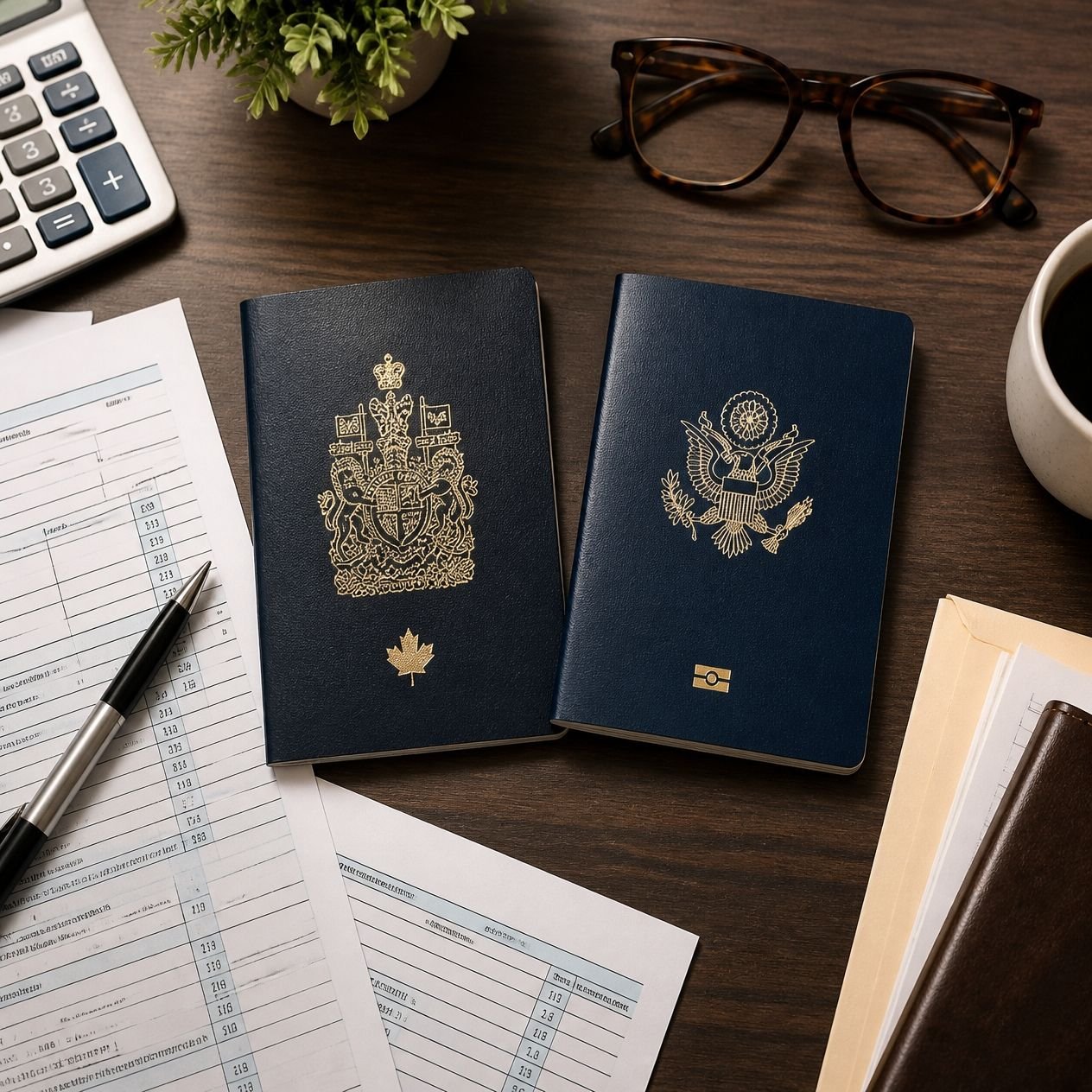
When someone passes away with assets in more than one country, the tax picture gets complicated fast. Canada, the US, and India each have different rules for taxing estates and inheritances. Without planning, the same asset can be taxed two or even three times.
Here is how cross-border estate taxation works and what you can do about it.
Canada: No estate tax, but deemed disposition
Canada does not have an estate tax or inheritance tax. But it has something that works similarly: a deemed disposition at death. When a person dies, CRA treats all their capital property as if it were sold at fair market value on the date of death. Any unrealized capital gains become taxable on the deceased person’s final return.
This applies to investment portfolios, real estate (other than the principal residence), RRSPs/RRIFs (fully taxable as income on the final return unless rolled over to a surviving spouse), and business interests.
The US: Estate tax with a cross-border twist
The US has a federal estate tax that applies to US citizens, green card holders, and non-residents who own US-situated assets (US real estate, US stocks, US business interests).
For 2024, the federal estate tax exemption is approximately US $13.6 million per person. Most Canadian residents will not hit this threshold on US assets alone. But the exemption for non-resident non-citizens is only US $60,000, unless the Canada-US tax treaty is applied. The treaty allows Canadian residents to claim a prorated share of the full US exemption based on the ratio of US assets to worldwide assets.
If you are a Canadian resident with US real estate or US investments, this treaty provision is critical. Without it, even a modest US property could trigger estate tax.
India: No inheritance tax, but capital gains on transfer
India abolished its estate duty in 1985. There is no inheritance tax. However, if inherited Indian property is later sold by the heir, capital gains tax applies based on the original owner’s cost of acquisition (with indexation). And if the heir is a Canadian resident, that gain is also reportable in Canada.
Where double taxation happens
The most common scenarios:
- A Canadian resident dies holding US stocks or US real estate. Canada taxes the deemed capital gain. The US may impose estate tax on the same assets. The Canada-US treaty provides a credit mechanism, but it must be claimed properly.
- A Canadian resident inherits property in India and sells it. India taxes the capital gain. Canada taxes the same gain. The Foreign Tax Credit prevents double taxation, but only if both returns are filed correctly and the Indian tax is documented.
- A US citizen dies while living in Canada. Both countries want to tax the worldwide estate. The treaty again provides relief, but the coordination between the Canadian final return and the US estate tax return (Form 706) is complex.
Planning steps to take now
- Document the cost base of all assets in each country.
- Understand which treaty applies and what credits are available.
- Review beneficiary designations on RRSPs, RRIFs, TFSAs, life insurance, and US retirement accounts.
- Consider a cross-border will. Many advisors recommend separate wills for assets in each country.
- If you hold US assets, calculate whether the prorated treaty exemption covers your situation.
Do not wait until it is too late
Estate planning across borders is not something to sort out after someone has passed. By then, the options are limited. The time to plan is while everyone is healthy and the assets are still flexible.
L&R Accounting works with clients who have assets in Canada, the US, and India. We can help you understand your exposure and coordinate with your estate lawyer to build a plan that minimizes tax across all jurisdictions.
Geetha Srinivasan, CPA (Ontario), CPA (US)
L&R Accounting Services Ltd.